

When someone needs a ride, they do not scroll through ten websites. They open Google Maps, glance at the top three taxi businesses, and tap one. If your taxi company is not in that map pack, you are invisible at the exact moment customers are ready to book.
The good news: ranking your taxi business on Google Maps in 2026 is not luck. It is a repeatable process. In this guide, we break down exactly how Google decides who ranks — and the step-by-step system we use at Star Digital Agency to get transportation businesses into the top three.
Why Google Maps Rankings Decide Who Gets the Booking
More than 80% of local ride bookings start with a map search like “taxi near me” or “airport taxi”. The businesses in the Google Map Pack (the top three listings with the map) capture the overwhelming majority of calls and bookings. Organic website rankings below the map get the leftovers.
For taxi, shuttle, and airport transfer companies, Google Maps is not just another channel — it is the channel. Rank there, and your phone rings. Do not rank there, and your competitors take every fare.
How Google Ranks Taxi Businesses: The 3 Signals
Google has confirmed it ranks local businesses using three core signals. Understand these, and every tactic below will make sense.
1. Relevance: How Well You Match the Search
Relevance means: does your business clearly offer what the searcher wants? A profile categorized as “Taxi Service” with services like “airport transfer” and “24/7 cab service” listed is far more relevant for “airport taxi” than a generic “Transportation Service” profile with an empty services section.
2. Distance: How Close You Are to the Searcher
You cannot change your location, but you can define your service areas properly so Google shows you for searches across every neighborhood, suburb, and airport zone you actually serve.
3. Prominence: How Trusted You Are Online
Prominence is your online reputation: review count and rating, citations across directories, backlinks, and overall brand mentions. This is the signal most taxi companies neglect — and the one that separates rank #1 from rank #8.
Step 1: Optimize Your Google Business Profile Like a Pro
Your Google Business Profile (GBP) is the single biggest ranking factor for map searches. Treat it as your most important landing page.
- Primary category: Set it to “Taxi Service”. Add secondaries like “Airport Shuttle Service” only if you truly offer them.
- Service areas: List every city, neighborhood, and airport zone you serve — not just your home city.
- Hours: Keep them accurate, including 24/7 if applicable and holiday hours.
- Photos: Upload high-quality images of your vehicles, drivers, and branding. Update them regularly to signal an active business.
- Description: Write a keyword-rich description in natural language: who you serve, where, and what makes you reliable.
- Attributes: Enable “24/7 service”, “online booking”, “airport pickup” where true.
- Booking link: Add your direct booking URL so riders convert without friction.
- Google Posts: Publish weekly updates — offers, new routes, service announcements. Active profiles outrank dormant ones.
Step 2: Build Reviews That Actually Move Rankings
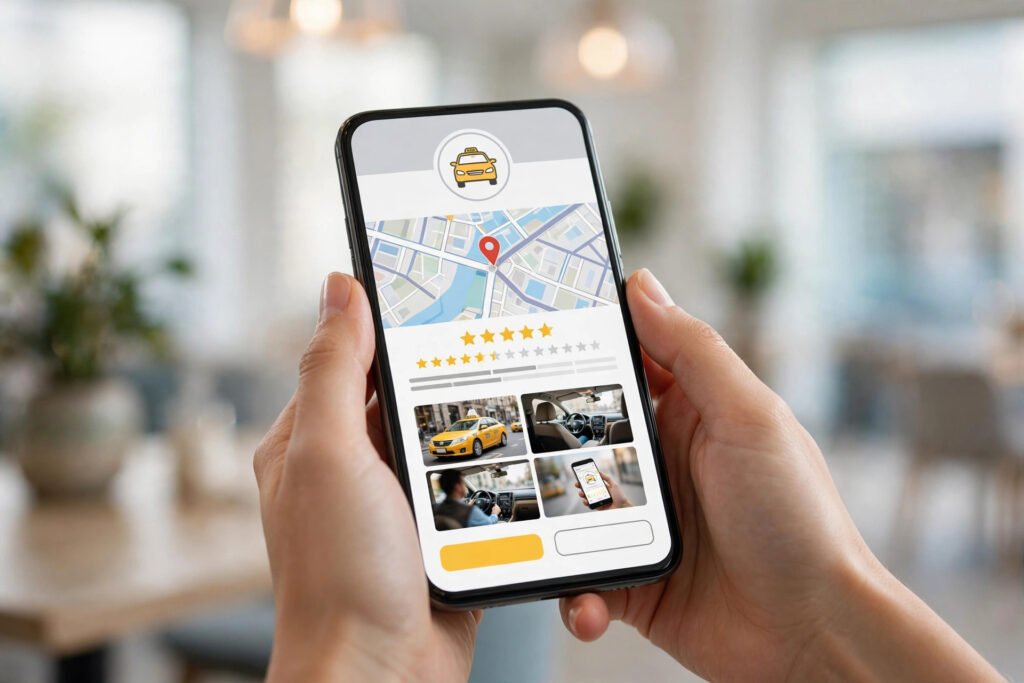
Reviews are the fuel of map pack rankings. A taxi company with 200 recent 5-star reviews will outrank an identical competitor with 20, almost every time.
- Ask every happy rider for a review — a simple QR code in the car works wonders.
- Respond to every review, positive and negative, within 24 hours.
- Never buy fake reviews. Google detects and penalizes them, and one suspension can erase months of progress.
- Aim for a steady flow of new reviews, not a one-time spike. Recency matters.
Step 3: Keep Your NAP Consistent Everywhere
NAP — Name, Address, Phone number — must be identical across your website, GBP, Facebook, Yelp, TripAdvisor, local directories, and anywhere else your business appears. Even small differences (“St.” vs “Street”) dilute Google’s trust in your business data. Audit your citations quarterly and fix inconsistencies.
Step 4: Create Location Pages on Your Website
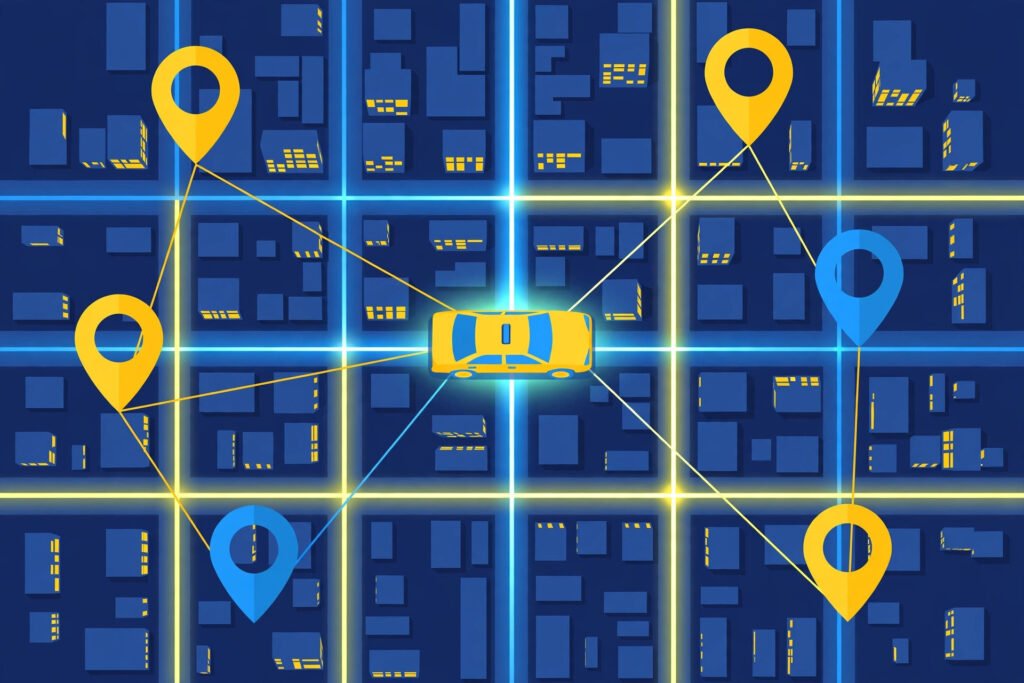
If you serve multiple areas, build a dedicated page for each one: “Taxi Service in [City]”, “Airport Taxi to [Airport]”, “24/7 Cab Service in [Neighborhood]”. Each page should have unique content about that area — pickup points, popular routes, local landmarks, and fare info. These pages capture hyperlocal searches your homepage never will, and they strengthen the relevance signal behind your map rankings.
Step 5: Publish Local Content That Answers Rider Questions
Blog content builds topical authority. Answer the questions your riders actually Google: airport transfer tips, fare guides, “how to book a taxi online”, event transportation advice. Every article is another chance to rank and another reason for local sites to link to you. Consistency beats volume — one genuinely useful post per month outperforms ten thin ones.
Step 6: Track, Measure, and Repeat
Local SEO is not “set and forget”. Track your map pack positions with a geo-grid rank tracker (rankings differ street by street), monitor GBP insights for calls and direction requests, and watch which queries drive bookings. Double down on what moves the needle; fix what does not. Most taxi companies see meaningful movement in 3–6 months of consistent work — map pack gains from GBP optimization often show first.
Common Mistakes That Keep Taxi Companies Invisible
- Wrong primary category (e.g., “Transportation Service” instead of “Taxi Service”)
- Unverified or incomplete Google Business Profile
- Service areas left blank or too narrow
- Inconsistent NAP across directories
- No review strategy — or worse, fake reviews
- A slow, non-mobile-friendly website with no clear booking button
- Zero location pages for the suburbs and airports they serve
Fix these before spending a single dollar on ads. Most visibility problems are foundational, not budget problems.
Frequently Asked Questions
How long does it take to rank a taxi business on Google Maps?
Most taxi companies see meaningful movement within 3–6 months in competitive cities, and sometimes in 6–10 weeks in smaller markets. Well-optimized Google Business Profiles often gain map pack visibility first.
Can a taxi business rank in suburbs it does not have an address in?
Yes. With properly defined service areas, location pages for each suburb, and consistent citations, Google can rank you for searches across your entire service region — not just your physical address.
Do Google Ads help organic map rankings?
No. Ads do not directly influence map pack rankings. But running ads while building organic visibility is a smart short-term bridge for bookings.
What is the most important ranking factor for taxi companies on Google Maps?
Your Google Business Profile completeness plus review velocity and rating. Nail those two, and you have done 60% of the work.
Get Your Taxi Business Into the Top 3
Ranking on Google Maps is a system, not a trick: an optimized profile, steady reviews, consistent citations, location pages, and useful content — executed month after month. That is exactly what we do for taxi, shuttle, and airport transfer companies worldwide at Star Digital Agency.
Want to know where your business stands right now? Get in touch for a free local SEO audit, and we will show you the exact gaps keeping you out of the map pack — and the plan to fix them.